


Subscribe now
Previous episodes
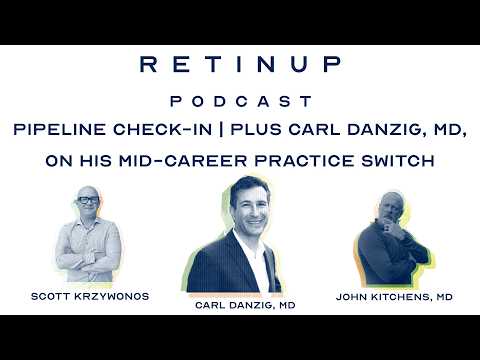
John and Scott take stock of 2026's biggest retina news — SOL-1 study data assessing Axpaxli (Ocular Therapeutix), FDA approval of Lytenava (Outlook Therapeutics), and the LUGANO study (near) miss for Duravyu (EyePoint Pharmaceuticals) — then look ahead to three imminent late-phase study readouts: Kodiak's DAYBREAK, Merck's BRUNELLO, and Annexon's ARCHER 2. Then Carl J. Danzig, MD, shares what it really costs to leave a practice at mid-career and build something new.
John Kitchens, MD, and Scott Krzywonos take stock of the three biggest retina news stories of 2026 — the SOL-1 superiority data for Axpaxli (Ocular Therapeutix), the FDA approval of Lytenava (Outlook Therapeutics), and the LUGANO Phase 3 (near) miss for Duravyu (EyePoint Pharmaceuticals) — and look ahead to three imminent late-phase readouts that could reshape the field before year's end: DAYBREAK for Zenkuda (Kodiak), BRUNELLO for Restoret (Merck/EyeBio), and ARCHER 2 for vonaprument (Annexon).
Carl J. Danzig, MD, then joins for a candid conversation about leaving a solo retina practice after 14 years, navigating a non-compete, commuting across Alligator Alley, and what it actually costs — personally and professionally — to make a major mid-career professional transition. He recently joined Fort Lauderdale Eye Institute as one of four retina specialists, beginning to see patients there on August 24, 2026.
Hosts: John Kitchens, MD, Scott Krzywonos
Topics Covered
2026 Pipeline Check-In: Catching Our Breath
Axpaxli / SOL-1 (Ocular Therapeutix): first superiority study in retina; at week 36, 74% of Axpaxli patients maintained vision vs. 56% on a single aflibercept injection; at 1 year, 66% of Axpaxli patients had not lost 10 letters; NDA filing planned for 2026.
Lytenava (Outlook Therapeutics): FDA-approved July 2026 for wet AMD — the first FDA-approved ophthalmic formulation of bevacizumab; measured commercial rollout planned for Q4 2026; full commercialization early 2027. Key unresolved question: impact on compounded bevacizumab access, particularly for non-wet AMD indications including DME, CRVO, BRVO, and myopic CNV.
Duravyu / LUGANO (EyePoint Therapeutics): primary non-inferiority endpoint missed in the full dataset; attributed to nine outlier patients in the treatment arm with vision loss unrelated to wet AMD; ad hoc analysis excluding those patients showed non-inferiority; LUCIA companion study topline data expected Q4 2026.
2026 Pipeline Check-In: What's Coming
Kodiak Sciences — DAYBREAK (Zenkuda / KSI-501): Phase 3 non-inferiority study for wet AMD; two investigational arms vs. aflibercept; topline data expected September 2026. Kodiak's prior KSI-301 missed its primary endpoint; lessons learned informed DAYBREAK's design.
Merck — BRUNELLO (Restoret / MK-3000): Wnt pathway agonist antibody acquired via EyeBio; Phase 3 non-inferiority trial for DME; data expected within 4 to 6 weeks of recording; a second Merck program — an ang-1 upregulator and VEGF inhibitor designed to activate the Tie2 receptor rather than merely inhibiting ang-2 — follows behind.
Annexon — ARCHER 2 (vanoprument / ANX007): C1q complement inhibitor for GA; distinct mechanism from C3 (pegcetacoplan) and C5 (avacincaptad pegol) inhibitors; Phase 2 showed a visual acuity benefit without slowing lesion growth; hypothesis: C1q inhibition protects photoreceptors upstream of RPE loss, with atrophy reduction expected to emerge over 12–24 months; Phase 3 primary endpoint is vision preservation, not lesion growth.
Carl J. Danzig, MD, on Switching Practices at Mid-Career
Background: Temple University medical school, Wills Eye tumor research, residency at Charles Drew (transferred to SUNY Downstate after program closure), fellowship at UT Southwestern; joined Rand Eye Institute as the practice's first and only retina specialist in 2012.
Solo practice realities: PI on 59 clinical trials as a solo retina specialist in an anterior segment practice; required extensive coverage arrangements and leveraged a full network of South Florida retina colleagues; elected to Retina Society.
Why he left: felt like "salmon swimming against the current" in an anterior segment culture; outgrowing his role; needed partners, shared call, and a practice aligned with his research identity and professional goals.
The transition year: geographic restriction meant commuting from Fort Lauderdale to Bonita Springs (Advanced Retina Institute) — across Alligator Alley — Tuesday through Thursday most weeks; often away five to six nights at a time including commercial speaking and international meetings.
The real costs: income went to zero during the gap; anxiety about the non-compete timeline; mental load of solo parenting for his wife; being a diminished version of himself at home after long stretches away. "Phil Rosenfeld, MD, told me I jumped out of an airplane holding my family's hand and no one had a parachute."
Fort Lauderdale Eye Institute: one of four retina specialists; seven minutes from home; active clinical trial program; practice aligned with his values. First patient day: August 24, 2026.
Advice to anyone considering a mid-career move: know your worth, don't undervalue yourself, move sooner rather than later if the fit is wrong, and build your network before you need it.
Key Takeaways
The three biggest retina stories of 2026 — SOL-1, Lytenava, and LUGANO — set up a fall season with multiple Phase 3 readouts that could further reshape the treatment landscape.
Annexon's ARCHER 2 is the most mechanistically distinct GA program in Phase 3 — a C1q inhibitor targeting photoreceptors upstream of RPE loss.
Leaving a practice at mid-career is a financial, legal, logistical, and deeply personal decision — Carl Danzig's year-long transition is a useful blueprint for anyone considering it.
Network-building early in training is the single most durable investment a retina specialist can make.
Sponsors
This episode is made possible by Genentech, maker of Vabysmo (faricimab-svoa). Hear peer perspectives and case studies in the Purple Chair series at Vabysmo-HCP.com.
This episode is brought to you by Ocular Therapeutix, a biopharmaceutical company working to redefine the retina experience across drug development, treatment, and outcomes. Learn more at OCUTX.com.
Credits
Production & Marketing: Laura Brown | Business Operations: Liz Hogan
🎧 Listen at RetinUp.com | Apple Podcasts | Spotify | YouTube

Three days after EyePoint Pharmaceuticals released topline LUGANO Phase 3 data, Jay S. Duker, MD, President & CEO, joins John Kitchens, MD, and Scott Krzywonos to break down what the results actually mean.
Three days after EyePoint Pharmaceuticals released LUGANO Phase 3 topline data, Jay S. Duker, MD, President & CEO, joins John Kitchens, MD, and Scott Krzywonos to explain what actually happened. Duravyu (vorolanib, Durasert E sustained-release insert) missed its primary non-inferiority endpoint in the full dataset — driven by nine patients in the treatment arm who lost 15+ letters for reasons unrelated to wet AMD control. Dr. Duker walks through the mechanism, the outlier analysis, and why he remains optimistic heading into LUCIA.
The Vitreoretinal View features Miles Harper, independent ophthalmology consultant, who uses two case studies — the collapse of Bionics' VR surgical headset and the slow adoption of heads-up 3D visualization — to examine why promising OR technologies fail to reach commercial success. The conversation closes with a grounded look at where AI and robotics are actually headed in the surgical suite.
Hosts: John Kitchens, MD, Scott Krzywonos
Topics Covered
Jay S. Duker, MD, on the LUGANO Data
Duravyu mechanism: small molecule TKI with pan-VEGF receptor activity (intracellular), plus PDGF (antifibrotic) and JAK1 (anti-inflammatory via IL-6) activity; delivered as a 2.7 mg bioerodible intravitreal insert every six months; systemic absorption at picogram levels only.
Study design: randomized, double-masked non-inferiority trial; aflibercept 2mg loading phase for all patients; 75% treatment-naive, 25% previously treated — the first wet AMD Phase 3 to enroll previously treated patients; primary endpoint averaged BCVA change at weeks 52 and 56.
Primary endpoint miss: control arm lost only 0.5% of patients to 15+ letter vision loss vs. historical ~4% for aflibercept 2mg — an unexpectedly strong comparator performance. Nine Duravyu patients lost 15+ letters for non-AMD reasons: six due to GA, two due to glaucoma, one due to repaired retinal detachment with resulting cataract.
Re-randomization analysis: CMO Ramiro Ribeiro, MD, PhD, re-randomized all 15+ letter losers across both arms ten times; every simulation produced non-inferiority with a mean letter difference of -1.3 to -2.0 — well within the margin.
Secondary data: 42% reduction in treatment burden vs. aflibercept (~2 fewer injections/year); 76% supplement-free at week 32; 54% supplement-free at week 56; four-micron OCT difference vs. control; supplement-free subgroup alone was non-inferior with a three-micron OCT difference.
GA data: Duravyu arm showed lower GA rates at end of trial (24%) vs. aflibercept arm (29%); no evidence drug causes or accelerates GA.
Regulatory path: LUCIA topline data expected Q4 2026; NDA submission planned 1H 2027 if positive. Precedents for one missed/one positive Phase 3 in retina: pegcetacoplan (DERBY/OAKS) and Lytenava.
Vitreoretinal View: OR Technology, Adoption & AI (Miles Harper)
Bionics case study: Israeli company developed a VR surgical headset with gesture-based controls — too disruptive to workflow, unclear value proposition vs. the analog microscope, and priced beyond what the marginal benefit could justify. First-mover disadvantage: arrived before the use case was fully defined.
Heads-up 3D visualization: similar adoption ceiling — compelling technology, real ergonomic benefits, but incremental rather than transformative improvement over the standard microscope; declining surgical reimbursements raise the break-even bar for surgical centers. Multiple entrants (Alcon, Zeiss, Heidelberg, Bausch, others) will drive prices down; generational familiarity with screens will drive adoption up.
AI and robotics: autonomous robotic surgery is coming — already deployed outside ophthalmology — but surgeon oversight will remain essential. Near-term AI value in the OR: image reading, fluid monitoring, cell counting, vitreous sensing — marginal, non-intrusive efficiencies that integrate without disrupting workflow. Contrast with AI as Skynet: the most useful applications will feel like spell check, not science fiction.
Key Takeaways
LUGANO missed its primary endpoint, but the secondary data and re-randomization analysis give EyePoint a credible argument that nine atypical patients — not drug failure — drove the results.
A positive LUCIA trial may be sufficient for NDA approval; precedent in retina for one missed and one positive Phase 3 exists.
OR technology adoption fails when it disrupts workflow without sufficient value exchange — the lesson from Bionics applies equally to heads-up 3D and will apply to AI and robotics.
The near-term AI opportunity in the OR is incremental efficiency, not autonomy.
Sponsors
This episode is made possible by Genentech, maker of Vabysmo (faricimab-svoa). Hear peer perspectives and case studies — including Dr. David A. Eichenbaum, MD, unpacking what drying looked like in a real-world DME patient — in the Purple Chair series at Vabysmo-HCP.com.
This episode is brought to you by Alcon, a global leader in eye care with an industry-leading breadth of surgical products and solutions, including Unity VCS. Learn more at unityvcs.com.
Credits
Production & Marketing: Laura Brown | Business Operations: Liz Hogan
🎧 Listen at RetinUp.com | Apple Podcasts | Spotify | YouTube
John Kitchens, MD, and Scott Krzywonos preview the AAO 2026 annual meeting in New Orleans — what's worth showing up for, who's on the podium, and which late-breaking Phase 3 data could change the field. Each host picks their top four talks, and the Vitreoretinal View covers the surgical program at Subspecialty Day.
John Kitchens, MD, and Scott Krzywonos break down the AAO 2026 annual meeting in New Orleans (October 9–12) — whether it still matters, what to catch at Subspecialty Day, and which late-breaking Phase 3 data presentations could move the field. Each host shares their top four talks, and the Vitreoretinal View covers the surgical program.
A quick correction from the prior episode: the SOL-1 primary endpoint was at month 9, not month 6, as stated in our previous episode. Corrections welcome at info@retinup.com.
Hosts: John Kitchens, MD, Scott Krzywonos
Topics Covered
AAO 2026: Does It Still Matter?
In-person attendance may be down post-COVID, but virtual access has expanded the meeting's reach significantly. Still a premier venue for late-breaking Phase 3 data and surgical education. New Orleans in October doesn't hurt.
John is on the podium in two places: the 2026 Debate Session (Friday, 2:45 PM — No Flap for Macular Hole) and a vitrectomy for floaters talk at Refractive Subspecialty Day. Plus, John pays tribute to Kirk Packo, MD — the legendary AAO debater — and his famous 2006 New Orleans talk calling out industry over Avastin access.
John's Top Four Talks
No. 4 — Friday, 5:10 PM: Ehsan Rahimy, MD, presents 36-month safety data from the PRIMA photovoltaic retinal implant trial in geographic atrophy. A European device that has hit mainstream news; risk of accelerating atrophy and debate over whether VA gains reflect true restoration or magnification make this one to watch.
No. 3 — Friday, 5:05 PM: Raj K. Maturi, MD, presents 12-month topline results from the Phase 2 ArMaDa trial of OCU-410, a modifier gene therapy for GA. Back-to-back with PRIMA; gene therapy for GA is the right target given the need for sustained delivery.
No. 2 — Saturday, 4:56 PM: Arshad M. Khanani, MD, MA, presents Phase 2 ELAAVATE data for RGX-314 (Regenxbio), a subretinal gene therapy for center-involved DME. Subretinal and suprachoroidal delivery routes both in development; data could signal what gene therapy for DME looks like before the Phase 3 wave hits.
No. 1 — Saturday, 5:10 PM: Donald J. D'Amico, MD, presents the BRUNELLO pivotal trial results for Remigromig (MK-3000, Merck) in DME — a Wnt pathway inhibitor that targets endothelial cell tight junctions rather than VEGF. A genuinely new mechanism; if it wins on VA and drying, it could be additive to anti-VEGF. Monthly ranibizumab as the comparator is defensible given the ride/rise data and Protocol T all-comers results. Merck's second program, tuspetinib (Tie2 activator, ANG1 pathway), is next up in the pipeline.
Scott's Top Four Talks
No. 4 — Friday, 8:30 AM: Jason Hsu, MD (Wills Eye Hospital), Top Journal Articles That Influenced My Practice. Not a single dataset — a real-world appraisal of what actually breaks through into practice.
No. 3 — Saturday, 4:37 PM: Nisha Acharya, MD, presents week 52 MEERKAT and SANDCAT data for vamikibart in uveitic macular edema. Week 16 data were presented at AAO 2025 and ARVO 2026; the 1-year read will be more definitive. Interesting wrinkle: higher dose won in MEERKAT, lower dose in SANDCAT.
No. 2 — Friday, 4:40 PM: Charles C. Wykoff, MD, PhD, presents the DAYBREAK Phase 3 trial for Kodiak Sciences — a three-arm study comparing KSI-301 (ABC anti-VEGF), KSI-501 (ABC anti-VEGF + anti-IL-6), and aflibercept. First time (we think) a sponsor has run two of their own candidates head-to-head against a control.
No. 1 — Saturday, 4:13 PM: Robert A. Sisk, MD, presents first-time pivotal VISTA trial results for laru-zova gene therapy (Beacon Therapeutics) for X-linked RP. Could be the second gene therapy approved in retina, and the first since Spark in 2017. Larger treatable population than RPE65-mediated LCA; safety around subretinal delivery in a pigmented retina will be key.
Vitreoretinal View: Surgical Talks at Subspecialty Day
Friday, 8:16 AM — Ninel Z. Gregori, MD: Subretinal administration of photoreceptor precursor cells in RP (Surgical Videos: Cool Cases and Complications). Subretinal photoreceptor delivery is distinct from gene therapy; anatomic and functional outcomes to watch.
Friday, 11:04 AM — Aleksandra V. Rachitskaya, MD: When to Worry and When Not to Worry About Retinoschisis. Schisis-related detachments are technically demanding with high PVR risk; looking for pearls on when to operate, laser options, tamponade choice.
Friday, 11:11 AM — Colin A. McCannel, MD: A Decade of 27-Gauge Vitrectomy Surgery. Less than 5% of US surgeons use 27-gauge; Alcon Unity system is optimizing flow and stiffness. Does 25-gauge still do everything 27 can without the compromises?
Saturday, 3:45 PM — Omesh P. Gupta, MD: Gore-Tex Scleral-Fixated IOL Technique (How Do I Do It).
Saturday, 3:52 PM — Murtaza K. Adam, MD: Yamane Technique IOL Placement (How Do I Do It).
Saturday, 4:06 PM — Glenn C. Yiu, MD, PhD: Suprachoroidal Injection Tips and Tricks. Increasingly relevant as suprachoroidal gene therapy delivery (RGX-314) advances and approved suprachoroidal steroid delivery matures.
Key Takeaways
AAO 2026 features an unusually dense late-breaking data slate: BRUNELLO, DAYBREAK, VISTA, MEERKAT/SANDCAT, PRIMA, and ArMaDa all read out at the same meeting.
BRUNELLO is the most mechanistically novel: a Wnt pathway inhibitor for DME that could eventually combine with anti-VEGF. VISTA is the most consequential for the inherited retinal disease field if positive.
Suprachoroidal delivery and 27-gauge vitrectomy are two surgical trends worth watching across multiple talks.
Correction: the SOL-1 primary endpoint was at month 9, not month 6, as stated on our previous episode.
Sponsors
This episode is made possible by Genentech, maker of Vabysmo (faricimab-svoa). Hear peer perspectives and case studies in the Purple Chair series, including Dr. David A. Eichenbaum on a real-world DME patient, at Vabysmo-HCP.com.
This episode is brought to you by Alcon, a global leader in eye care, including Unity VCS. Learn more at unityvcs.com.
Credits
Production & Marketing: Laura Brown | Business Operations: Liz Hogan
🎧 Listen at RetinUp.com | Apple Podcasts | Spotify | YouTube