Pipeline Check-In | Plus Carl Danzig, MD, on His Mid-Career Practice Switch
John Kitchens, MD, and Scott Krzywonos take stock of the three biggest retina news stories of 2026 — the SOL-1 superiority data for Axpaxli (Ocular Therapeutix), the FDA approval of Lytenava (Outlook Therapeutics), and the LUGANO Phase 3 (near) miss for Duravyu (EyePoint Pharmaceuticals) — and look ahead to three imminent late-phase readouts that could reshape the field before year's end: DAYBREAK for Zenkuda (Kodiak), BRUNELLO for Restoret (Merck/EyeBio), and ARCHER 2 for vonaprument (Annexon).
Carl J. Danzig, MD, then joins for a candid conversation about leaving a solo retina practice after 14 years, navigating a non-compete, commuting across Alligator Alley, and what it actually costs — personally and professionally — to make a major mid-career professional transition. He recently joined Fort Lauderdale Eye Institute as one of four retina specialists, beginning to see patients there on August 24, 2026.
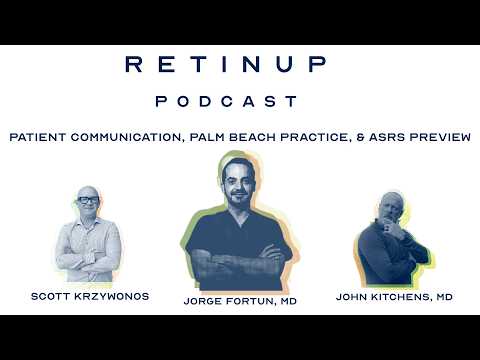
Hosts: John Kitchens, MD, Scott Krzywonos
Topics Covered
2026 Pipeline Check-In: Catching Our Breath
Axpaxli / SOL-1 (Ocular Therapeutix): first superiority study in retina; at week 36, 74% of Axpaxli patients maintained vision vs. 56% on a single aflibercept injection; at 1 year, 66% of Axpaxli patients had not lost 10 letters; NDA filing planned for 2026.
Lytenava (Outlook Therapeutics): FDA-approved July 2026 for wet AMD — the first FDA-approved ophthalmic formulation of bevacizumab; measured commercial rollout planned for Q4 2026; full commercialization early 2027. Key unresolved question: impact on compounded bevacizumab access, particularly for non-wet AMD indications including DME, CRVO, BRVO, and myopic CNV.
Duravyu / LUGANO (EyePoint Therapeutics): primary non-inferiority endpoint missed in the full dataset; attributed to nine outlier patients in the treatment arm with vision loss unrelated to wet AMD; ad hoc analysis excluding those patients showed non-inferiority; LUCIA companion study topline data expected Q4 2026.
2026 Pipeline Check-In: What's Coming
Kodiak Sciences — DAYBREAK (Zenkuda / KSI-501): Phase 3 non-inferiority study for wet AMD; two investigational arms vs. aflibercept; topline data expected September 2026. Kodiak's prior KSI-301 missed its primary endpoint; lessons learned informed DAYBREAK's design.
Merck — BRUNELLO (Restoret / MK-3000): Wnt pathway agonist antibody acquired via EyeBio; Phase 3 non-inferiority trial for DME; data expected within 4 to 6 weeks of recording; a second Merck program — an ang-1 upregulator and VEGF inhibitor designed to activate the Tie2 receptor rather than merely inhibiting ang-2 — follows behind.
Annexon — ARCHER 2 (vanoprument / ANX007): C1q complement inhibitor for GA; distinct mechanism from C3 (pegcetacoplan) and C5 (avacincaptad pegol) inhibitors; Phase 2 showed a visual acuity benefit without slowing lesion growth; hypothesis: C1q inhibition protects photoreceptors upstream of RPE loss, with atrophy reduction expected to emerge over 12–24 months; Phase 3 primary endpoint is vision preservation, not lesion growth.
Carl J. Danzig, MD, on Switching Practices at Mid-Career
Background: Temple University medical school, Wills Eye tumor research, residency at Charles Drew (transferred to SUNY Downstate after program closure), fellowship at UT Southwestern; joined Rand Eye Institute as the practice's first and only retina specialist in 2012.
Solo practice realities: PI on 59 clinical trials as a solo retina specialist in an anterior segment practice; required extensive coverage arrangements and leveraged a full network of South Florida retina colleagues; elected to Retina Society.
Why he left: felt like "salmon swimming against the current" in an anterior segment culture; outgrowing his role; needed partners, shared call, and a practice aligned with his research identity and professional goals.
The transition year: geographic restriction meant commuting from Fort Lauderdale to Bonita Springs (Advanced Retina Institute) — across Alligator Alley — Tuesday through Thursday most weeks; often away five to six nights at a time including commercial speaking and international meetings.
The real costs: income went to zero during the gap; anxiety about the non-compete timeline; mental load of solo parenting for his wife; being a diminished version of himself at home after long stretches away. "Phil Rosenfeld, MD, told me I jumped out of an airplane holding my family's hand and no one had a parachute."
Fort Lauderdale Eye Institute: one of four retina specialists; seven minutes from home; active clinical trial program; practice aligned with his values. First patient day: August 24, 2026.
Advice to anyone considering a mid-career move: know your worth, don't undervalue yourself, move sooner rather than later if the fit is wrong, and build your network before you need it.
Key Takeaways
The three biggest retina stories of 2026 — SOL-1, Lytenava, and LUGANO — set up a fall season with multiple Phase 3 readouts that could further reshape the treatment landscape.
Annexon's ARCHER 2 is the most mechanistically distinct GA program in Phase 3 — a C1q inhibitor targeting photoreceptors upstream of RPE loss.
Leaving a practice at mid-career is a financial, legal, logistical, and deeply personal decision — Carl Danzig's year-long transition is a useful blueprint for anyone considering it.
Network-building early in training is the single most durable investment a retina specialist can make.
Sponsors
This episode is made possible by Genentech, maker of Vabysmo (faricimab-svoa). Hear peer perspectives and case studies in the Purple Chair series at Vabysmo-HCP.com.
This episode is brought to you by Ocular Therapeutix, a biopharmaceutical company working to redefine the retina experience across drug development, treatment, and outcomes. Learn more at OCUTX.com.
Credits
Production & Marketing: Laura Brown | Business Operations: Liz Hogan
🎧 Listen at RetinUp.com | Apple Podcasts | Spotify | YouTube